Key Takeaways:
- BambooHR onboarding for your HR team means getting your HR staff confident and fully operational on the platform, which is different from onboarding new employees through it.
- The first 30 days set the tone for long-term adoption, so a structured week-by-week plan prevents messy data, missed configurations, and low usage later.
- Preparation before day one, including clean employee data and clear permission levels, saves more time than any single setup step.
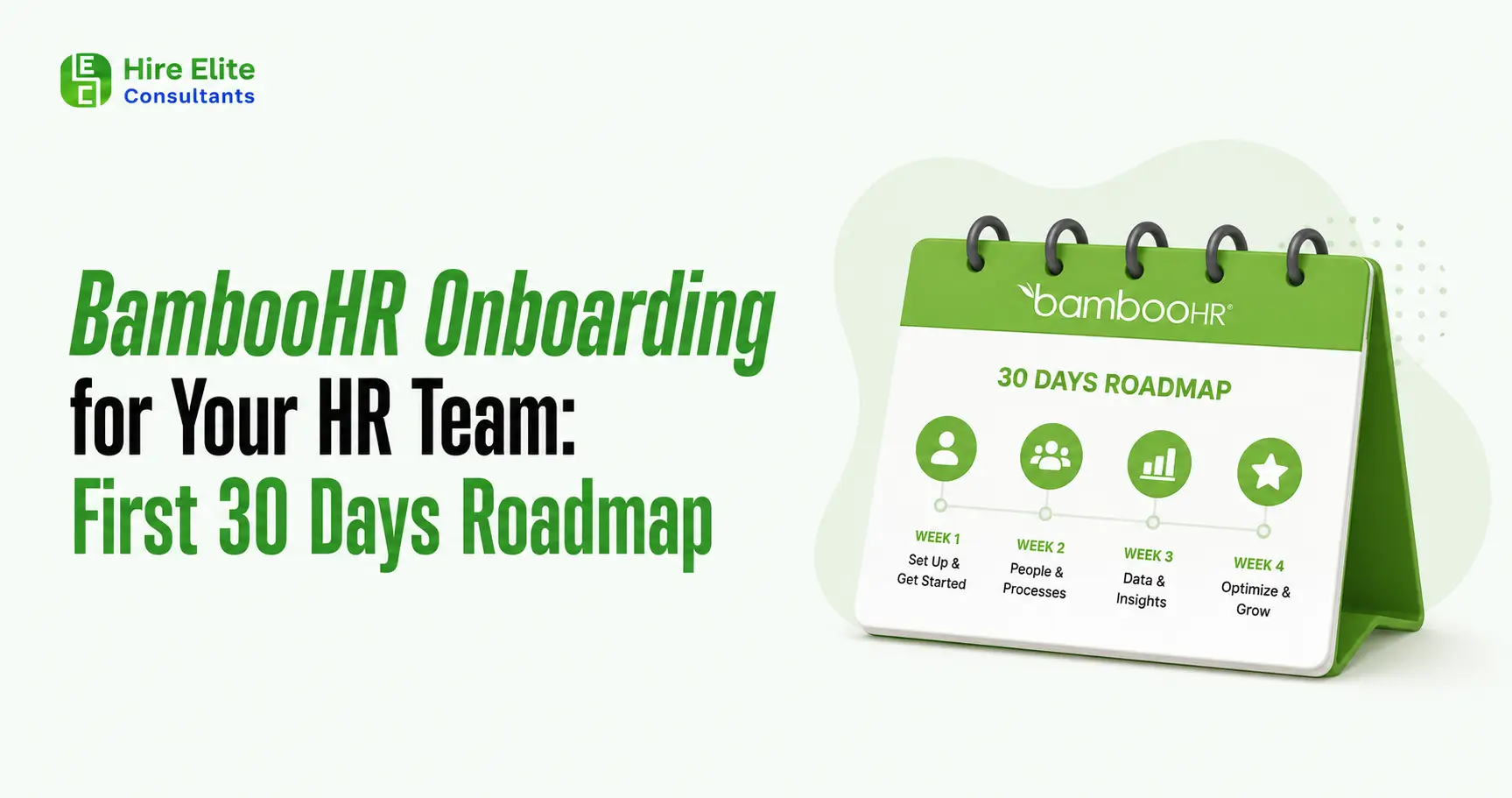
- A sensible sequence works best: build the foundation in Week 1, configure workflows in Week 2, add reporting and integrations in Week 3, and drive adoption in Week 4.
- Most BambooHR onboarding problems come from rushing data migration, skipping permission planning, and treating go-live as the finish line instead of the starting point.
- If your team is short on time or implementing several modules at once, a BambooHR consultant can shorten the ramp and help you avoid rework.
Rolling out a new HR platform is exciting until your team logs in for the first time and realizes nobody agrees on how records should be structured, who can see what, or where time-off requests go. BambooHR onboarding is the process of getting your HR team genuinely comfortable and productive on the system, and the first 30 days decide whether the tool becomes a daily habit or an expensive login nobody uses.
This roadmap breaks those 30 days into a practical, week-by-week plan so your HR team can move from setup to confident daily use without the usual stumbles.
What Does BambooHR Onboarding for Your HR Team Actually Mean?
BambooHR onboarding for your HR team means training and equipping your HR staff to run the platform confidently, not onboarding new hires through it. These two ideas share a word but solve different problems. Employee onboarding is about welcoming new staff. Team onboarding is about making sure the people who manage HR know how to configure records, run reports, set permissions, and support everyone else.

This distinction matters because most companies focus entirely on the employee experience and forget that the HR team needs its own ramp first. If your HR administrators do not understand permission levels, approval chains, or reporting logic, every downstream process inherits that confusion.
Getting your HR team fluent early is what turns BambooHR from a database into a working HR operating system. Once your team is confident, building a smoother experience for new staff becomes far easier, which is where a strong onboarding process for new hires starts to pay off.
Get Your BambooHR Setup Right in the First 30 Days
The first 30 days on BambooHR decide whether your team adopts the platform or quietly falls back to spreadsheets. Hire Elite Consultants helps you skip the trial and error, from cleaning and migrating your employee data to configuring permissions, workflows, reporting, and integrations around how your team actually works. Instead of guessing your way through setup, you get a clear, structured rollout that gets your HR team confident and fully operational fast.
Speak with a BambooHR specialist to map out your 30-day plan and start on a clean foundation.
Why the First 30 Days on BambooHR Matter Most
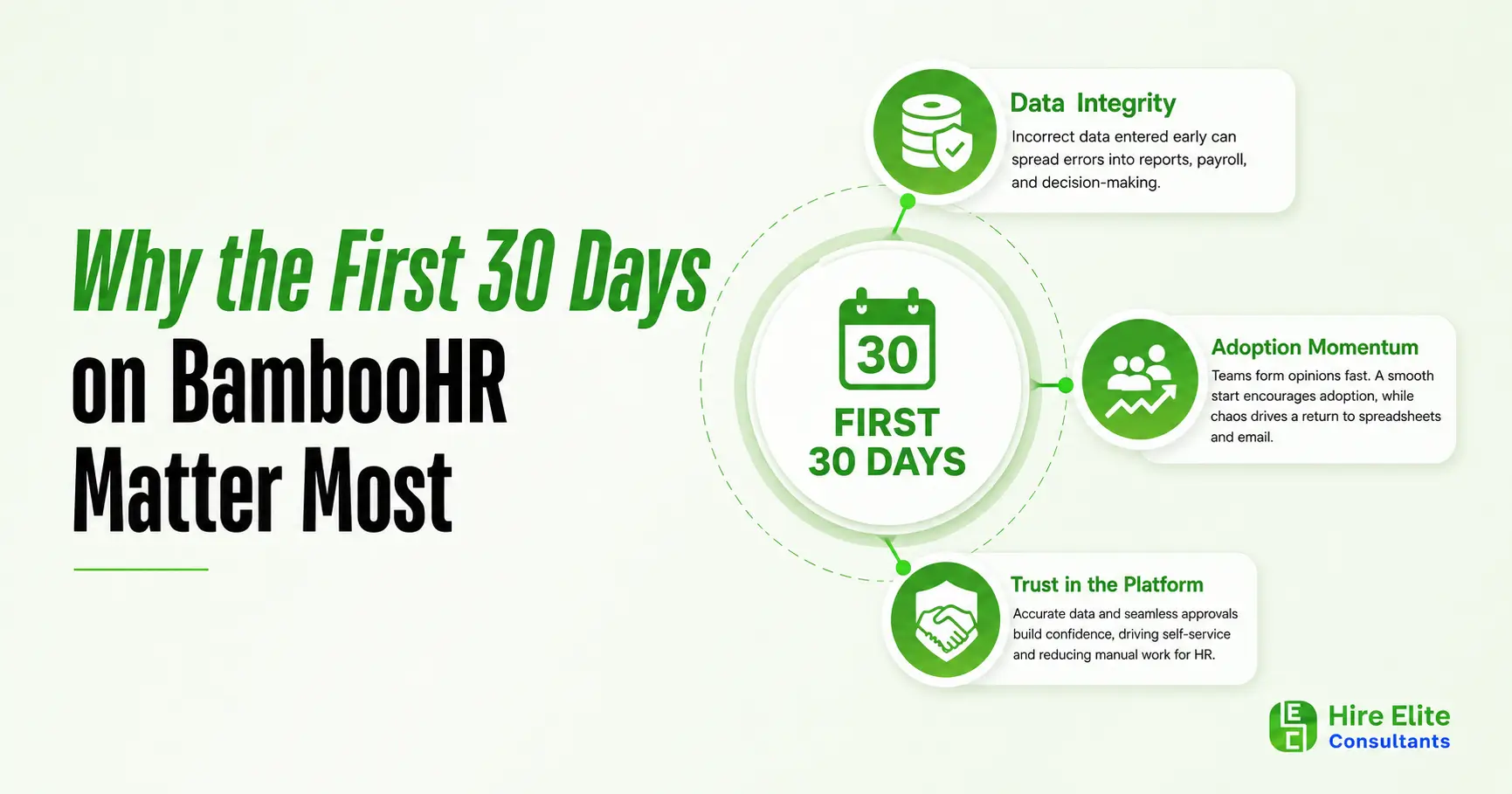
The first 30 days matter most because early habits, data quality, and configuration choices become very hard to reverse once people start using the system daily. A rushed setup leaves you cleaning up duplicated records and reworking permissions for months. A deliberate setup gives you a clean foundation that scales as you grow.
Three things are genuinely at stake in this window:
- Data integrity. Employee records, compensation history, and time-off balances entered incorrectly early tend to spread errors into reports and payroll.
- Adoption momentum. Teams form opinions fast. If the first two weeks feel chaotic, people quietly revert to spreadsheets and email.
- Trust in the platform. When managers and employees see accurate data and smooth approvals early, they lean into self-service instead of routing everything through HR.
There is a people-side risk too. A clunky rollout can frustrate managers and employees at the exact moment you want them engaged. Paying attention to early friction is part of the same discipline that helps you catch employee turnover warning signs before they grow into real problems.
What to Prepare Before Day One
Preparation is the single highest-return activity in your entire BambooHR onboarding. The teams that gather their data and decisions before touching the platform consistently finish faster and with fewer errors than teams that improvise as they go.
Data and Documents to Gather
Before you create a single record, pull together the information you will need so setup becomes data entry rather than decision-making:
- Current employee roster with names, titles, departments, and start dates
- Compensation details and pay schedules
- Reporting relationships for the org chart
- Existing time-off balances and PTO policies
- Company documents such as handbooks, policies, and required forms
- Benefits enrollment information if you plan to manage it in-platform
Clean this data in a spreadsheet first. Fixing a typo in a spreadsheet takes seconds; fixing it across linked records after go-live takes far longer. If you want a deeper technical walkthrough of the build itself, the BambooHR setup and HRIS implementation guide covers the mechanics in detail.
Roles, Permissions, and Access Levels
Decide who can see and do what before you invite anyone in. BambooHR uses access levels to control visibility, and retrofitting permissions after people are already active is a common source of privacy headaches. Map at least three tiers: full administrators, managers with team-level access, and employees with self-service access to their own information. Write these decisions down so the whole HR team applies them consistently.
BambooHR Onboarding: 30-Day Roadmap at a Glance
The table below summarizes what your HR team should focus on each week, the key milestone to hit, and the mistake to avoid during that phase.
| Week | Primary Focus | Key Tasks | Milestone to Hit | Mistake to Avoid |
| Prep (Before Day 1) | Data and decisions | Gather and clean employee data, define permission levels, document PTO and approval policies | Clean, verified data ready to import | Improvising decisions during setup |
| Week 1 | Foundation and core setup | Configure company settings, import employee records, build org chart, apply permissions | Every profile shows accurate, complete data | Rushing data migration |
| Week 2 | Workflows and self-service | Set up time-off policies, test approvals end to end, enable self-service, build onboarding templates | A PTO request flows correctly from submit to approval | Launching workflows without testing |
| Week 3 | Reporting and integrations | Build standard reports, configure performance reviews, connect payroll and calendar integrations | Leadership can pull accurate reports in one click | Trusting integrations without a test run |
| Week 4 | Adoption and enablement | Run role-specific training, create an internal reference guide, open a feedback loop | HR team, managers, and employees use the system daily | Treating go-live as the finish line |
Week 1 — Foundation and Core Setup
Week 1 is about building a clean, accurate base. Resist the urge to switch on every feature. Your goal this week is a company profile and employee records you can trust.
Start by configuring your company settings: legal name, locations, departments, divisions, and job titles. These fields feed everything else, so accuracy here prevents downstream cleanup. Next, import or enter employee records using the data you prepared.
If you are migrating to a larger workforce, use BambooHR’s import tools rather than manual entry, and verify a sample of records against your source data before trusting the full set.
Then build your org chart and confirm reporting lines, since these relationships drive approval workflows later. Finally, apply the permission levels you defined during preparation. By the end of Week 1, your HR team should be able to open any employee profile and see correct, complete information. That single milestone is the foundation everything else rests on.
Week 2 — Configuring HR Workflows and Self-Service
Week 2 shifts from static data to the processes your team runs every day. This is where BambooHR starts saving real time, because well-configured workflows remove manual back-and-forth.
Time-Off and PTO Configuration
Set up your time-off policies to match your actual company rules, including accrual rates, carryover limits, and approval chains. Test a request end to end before rolling it out: submit as an employee, approve as a manager, and confirm the balance updates correctly. Getting PTO right early prevents the balance disputes that erode trust in any HR system.
Employee Self-Service and Onboarding Templates
Turn on self-service so employees can update personal details, view pay information, and request time off without emailing HR. Then build onboarding templates and task lists for new hires, so future onboarding runs on a repeatable checklist instead of memory.
This is the point where your platform setup connects directly to the employee experience, and a thoughtful onboarding process for new hires becomes something you can deliver consistently every time someone joins.
Week 3 — Reporting, Performance, and Integrations
Week 3 is where BambooHR becomes a decision-making tool rather than a record keeper. With clean data and working workflows in place, you can now build the outputs and connections that make the platform genuinely useful to leadership.
Start with reporting. Set up the standard reports your team relies on, such as headcount, turnover, time-off usage, and compensation summaries. Save the ones you will run repeatedly so they are one click away. Accurate reporting is only possible because you protected data integrity in Week 1, which is why sequencing matters.
If your plan includes performance management, configure your review cycles, goals, and feedback settings this week. Thoughtful configuration here helps you avoid the kind of process gaps that lead to common performance review mistakes that quietly hurt employee growth.
Finally, connect the integrations that reduce double entry, such as payroll, calendars, or your applicant tracking tool. Test each integration with a small data set before relying on it.
Week 4 — Adoption, Training, and Team Enablement
Week 4 is about people, not settings. A perfectly configured platform still fails if your HR team and the wider company do not use it. This final week turns your setup into a habit.
Run focused training sessions for three groups: your HR administrators, managers, and employees. Keep each session role-specific and short. Administrators need depth on configuration and reporting. Managers need to know how to approve requests and view their teams. Employees only need the handful of self-service actions they will actually perform.
Create a simple internal reference, such as a one-page guide or a short recorded walkthrough, so people can answer their own questions without contacting HR. Then set up a feedback loop for the first few weeks of live use.
Ask what feels confusing, watch where requests get stuck, and adjust settings quickly. Adoption is won in these small corrections, and treating go-live as a starting point rather than a finish line is what separates smooth rollouts from stalled ones.
Talk to a BambooHR Specialist About Your 30-Day Onboarding Plan
Planning a BambooHR rollout or already stuck mid-setup? Tell us where your HR team is today, and we’ll help you build a practical 30-day onboarding plan, from data prep and core configuration to workflows, reporting, and team adoption. Whether you need a full implementation or just expert guidance to avoid costly rework, our team is ready to help.
Explore our BambooHR consulting services or fill out the form below and a specialist will get back to you with clear next steps.
Common BambooHR Onboarding Mistakes to Avoid
Most BambooHR onboarding problems are predictable, which means they are also preventable. Watch for these recurring mistakes:
- Rushing data migration. Importing messy or unverified data creates errors that surface for months.
- Skipping permission planning. Setting access levels after people are active risks exposing sensitive information.
- Turning on every feature at once. Activating all modules in Week 1 overwhelms your team and buries the essentials.
- Ignoring workflow testing. Launching PTO or approvals without a test run leads to balance disputes and stuck requests.
- Treating go-live as the end. Onboarding continues past launch; the first weeks of live use need active support.
- Neglecting role-specific training. Generic training leaves managers and employees unsure of the few actions they actually need.
Avoiding these does not require special expertise, only discipline and a clear sequence. If your team is stretched thin or implementing several modules simultaneously, that is often the right moment to bring in outside help.
Final Thoughts
A successful BambooHR onboarding for your HR team is less about the software and more about the plan. When you prepare your data before day one, build a clean foundation in Week 1, configure workflows in Week 2, add reporting and integrations in Week 3, and drive adoption in Week 4, you give your HR team a system they trust and use daily. The first 30 days are your best chance to get it right, and a deliberate roadmap beats a rushed launch every time.
If you would rather move faster or avoid rework, a specialist can help you scope the rollout, migrate data cleanly, and configure the platform around how your team actually works. Explore our BambooHR consulting services or request a consultation to build a 30-day plan that fits your company.