Performance reviews should be the moment when employees gain clarity, motivation, and a clear path forward. Yet in most organizations, they accomplish the opposite. Managers walk in unprepared, employees walk out confused, and HR teams are left wondering why engagement scores keep dropping.
The truth is, the review process itself is often the problem, not the people involved in it. When performance conversations are mishandled, they quietly stall career growth, weaken trust, and push your best talent toward the exit.
If you lead a team, manage HR operations, or run a growing business, understanding where these reviews go wrong is the first step toward building a culture where people actually develop. Below, we break down the most damaging performance review mistakes, why they hurt employee growth, and what high-performing companies do differently to turn reviews into a genuine development tool.
Why Performance Reviews Still Matter in 2026
Despite the rise of continuous feedback tools, AI-driven HR platforms, and modern performance management software, formal reviews remain a critical checkpoint. They shape promotions, compensation decisions, succession planning, and career trajectories. When done well, they reinforce company values, align individual goals with business outcomes, and build psychological safety. When done poorly, they damage retention, lower morale, and create blind spots that quietly erode team performance over time.

Companies that treat reviews as a strategic growth tool, rather than a once-a-year compliance task, consistently see stronger employee engagement, better internal mobility, and healthier manager-employee relationships. The shift toward people-first HR practices has made reviews more important, not less.
7 Most Common Performance Review Mistakes That Stall Employee Growth
Most performance review failures fall into a predictable set of patterns. Identifying these patterns inside your organization is the fastest way to course-correct before they damage retention and culture.
1. Relying on Recency Bias Instead of Full-Year Performance
One of the most damaging mistakes in any review cycle is judging an employee based on the last few weeks of work rather than their full performance period. Recency bias skews ratings, overlooks meaningful contributions made earlier in the year, and creates a sense of unfairness that employees quickly pick up on. Managers who do not document performance throughout the year are forced to rely on memory, which almost always favors the most recent events, both positive and negative.
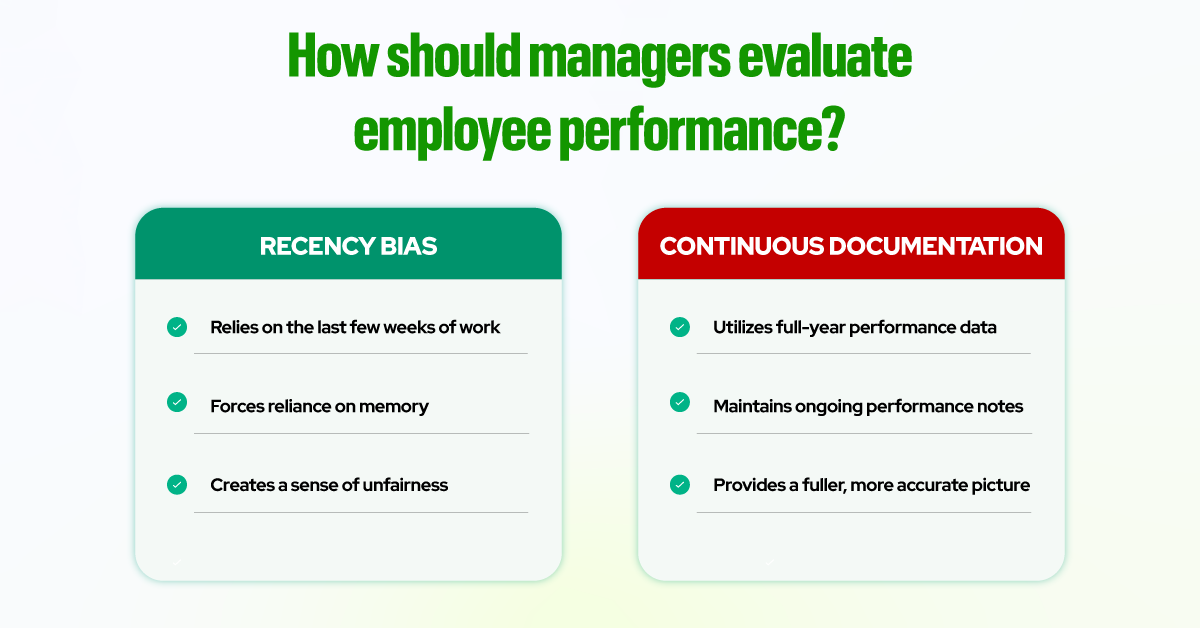
To counter this, managers should maintain ongoing performance notes, track wins and challenges in real time, and use a centralized HR system to capture milestones consistently. This creates a fuller, more accurate picture of how an employee performed across the entire review window.
2. Giving Vague, Generic Feedback
“Great job this year” and “You need to improve communication” are two of the most common phrases employees hear, and both are useless without context. Vague feedback leaves employees guessing about what they did well, what they need to change, and how to grow. It also signals that the manager did not invest time in preparing a meaningful evaluation.
Strong feedback is specific, behavior-based, and tied to outcomes. Instead of saying “improve communication,” a manager should describe the situation, explain the impact, and offer a clear path forward. Specific examples turn feedback into a learning moment rather than a checkbox.
3. Treating the Review as a One-Way Conversation
When managers dominate the review meeting, employees disengage. A performance review should be a two-way dialogue where employees share their own perspective, discuss obstacles, and contribute to their development plan. One-way reviews feel like verdicts rather than conversations, which weakens trust and reduces follow-through on improvement goals.
Encouraging self-assessments, asking open-ended questions, and giving employees real time to respond transforms the review into a partnership. This shift is one of the strongest predictors of post-review engagement and growth.
4. Linking Every Review Directly to Compensation Without Development Focus
When reviews become purely transactional, focused only on raises, bonuses, or promotions, employees stop hearing the developmental message entirely. They walk in thinking about money and walk out remembering only the number. While compensation discussions matter, blending them too tightly with development feedback waters down both.
Many high-performing companies now separate compensation conversations from performance development discussions. This allows employees to absorb growth feedback without distraction and gives managers space to focus on long-term coaching.
5. Skipping Goal Setting or Setting Unrealistic Goals
A review without forward-looking goals is just a report card. Without clear, measurable, and realistic objectives, employees leave the meeting without direction. Worse, when managers set goals that are vague, unattainable, or disconnected from business priorities, employees lose motivation and trust in the process.
Effective goal setting follows a structured framework, ties individual targets to team and company outcomes, and includes checkpoints throughout the year. Modern HR platforms like BambooHR make this easier by integrating goal tracking with ongoing performance conversations.
6. Avoiding Difficult Conversations
Some managers soften feedback so much that the employee never realizes there is a problem. Others avoid the conversation altogether, hoping the issue resolves itself. Both approaches harm the employee, the team, and the business. When underperformance goes unaddressed, it creates resentment among high performers and denies the struggling employee the chance to improve.
Honest, respectful, and timely feedback is one of the most generous things a manager can offer. Avoidance is not kindness, it is neglect dressed up as politeness.
7. Using Inconsistent Standards Across the Team
When two employees doing similar work receive wildly different ratings based on manager preference rather than performance, trust collapses. Inconsistent standards create a sense of favoritism, fuel internal politics, and make it nearly impossible to defend promotion or compensation decisions.
Calibration sessions, standardized rubrics, and clear performance criteria help eliminate this bias. HR teams should facilitate these calibrations to ensure ratings reflect actual performance rather than personality fit.
How These Mistakes Quietly Hurt Long-Term Employee Growth
The damage from poor performance reviews rarely shows up immediately. It builds over months and years. Employees who feel unheard stop sharing ideas. High performers who feel overlooked start exploring outside opportunities.
Mid-level contributors who never receive clear feedback plateau in their roles. Over time, the organization loses institutional knowledge, leadership pipelines weaken, and turnover costs climb.
Equally important, poor reviews damage manager credibility. Once an employee loses confidence in their manager’s ability to evaluate fairly, every future conversation, coaching moment, and stretch assignment is filtered through that mistrust. Rebuilding that trust takes far longer than getting the review right the first time.
Build Smarter Performance Reviews With Expert BambooHR Consulting
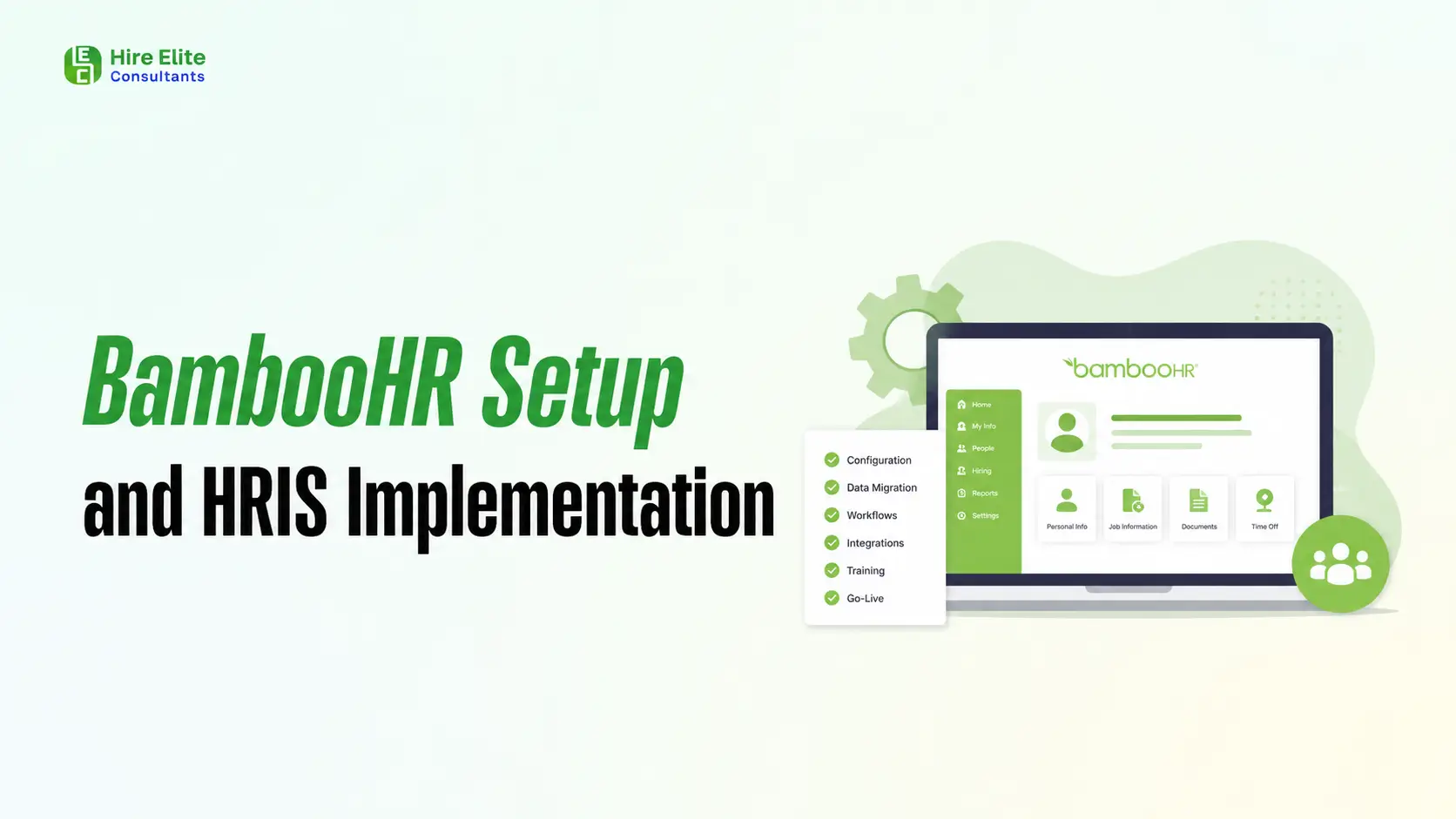
If your performance review process feels outdated, inconsistent, or disconnected from real employee growth, the right HR technology and strategy can change that. At Hire Elite Consultants, our BambooHR Consulting Services are designed to help businesses streamline HR processes, optimize workflows, and unlock the full potential of BambooHR.
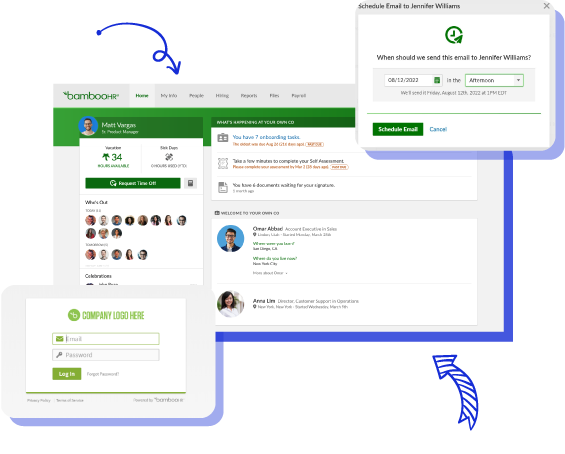
Whether you need help configuring performance management modules, automating review cycles, setting up goal tracking, or training your managers to deliver better feedback, we partner with you end-to-end. From implementation and customization to ongoing support, our team builds HR solutions that drive productivity, retention, and measurable business results.
If you’re ready to turn performance reviews into a real growth engine, let’s talk about how BambooHR can work harder for your team.
What Great Performance Reviews Look Like Instead
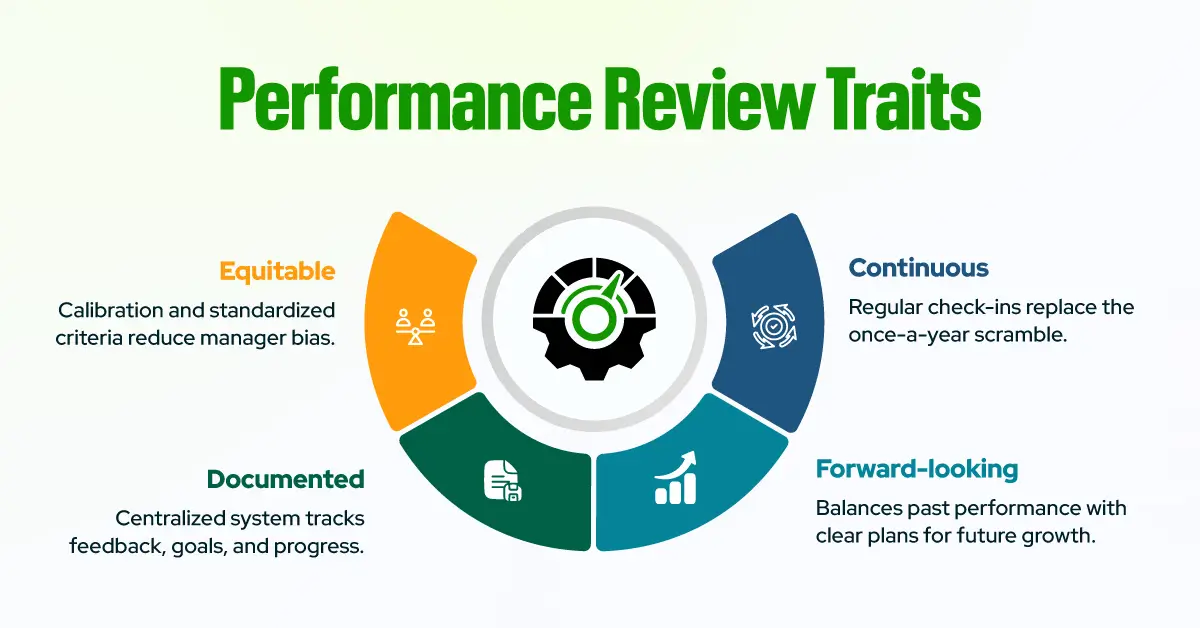
The strongest performance review processes share a few clear traits. They are continuous rather than annual, with regular check-ins replacing the once-a-year scramble. They are documented in a centralized system so that feedback, goals, and progress are easy to track.
They are forward-looking, balancing reflection on past performance with clear plans for future growth. And they are equitable, supported by calibration and standardized criteria that reduce manager bias.
Companies that invest in this kind of structured, development-focused review process consistently outperform competitors on retention, engagement, and internal promotion rates. The review stops being something employees dread and becomes something they actually look forward to.
How HR Leaders Can Drive the Shift
HR leaders sit in the best position to redesign the performance review experience. The work starts with auditing the current process, gathering feedback from managers and employees, and identifying where the biggest gaps exist. From there, HR can introduce updated frameworks, train managers on delivering specific and behavior-based feedback, and roll out technology that supports ongoing performance conversations rather than annual events.
Change management matters here. Managers need coaching, employees need clear expectations, and leadership needs to model the behaviors they want to see. When HR drives this shift intentionally, the entire culture of feedback inside the organization improves.
Turn Your Performance Review Process Into a Growth Engine
Performance reviews will always be one of the most influential moments in an employee’s experience. They either accelerate growth or quietly shut it down. By eliminating the most common mistakes, building a structured and fair process, and leveraging the right HR technology, you can create a review system that develops people, strengthens managers, and protects your culture.
If you want expert guidance on configuring BambooHR to support modern, growth-focused performance reviews, Hire Elite Consultants is ready to help. Our BambooHR Consulting Services cover implementation, customization, automation, and ongoing optimization, so your HR team can focus on people while we handle the platform. Reach out today and let’s build an HR process that actually drives results.